
-
 Savannah Bullard/NASANASA's Reid Wiseman and Victor Glover are hanging up their flight suits but remain committed to working with NASA as it continues its return to the moon.
 -
 James Gathany/CDCLearning what attracts the pests could be useful to designing repellents that deter them from biting people and reducing local populations. A recent FIU study shows humans aren't the only fussy eaters.


-
 On "The Florida Roundup," NASA's Jeremy Perkins talked about the goal of the telescope before its launch at the end of the month.
 -
 Blue Origin's CEO Dave Limp said the anomaly originated at a valve that controls the flow of oxygen into one of the rocket's seven BE-4 engines.
 -
 While no one observed the actual impact, a telescope in Chile spotted what astronomers have identified as the debris plume resulting from the high-speed crash.
 -
 Luke Delaney, who considers Volusia County his home, is serving as the pilot for NASA's Crew-13 mission, which will take him and three others to the ISS in SpaceX's Crew Dragon capsule.
 -
 In this UF study using AI, simulations try to predict how certain decisions create effect domino effect throughout the airport.
 -
 The Nancy Grace Roman Space Telescope will study things like dark matter and faraway planets. It's now fueled and ready for launch, one step closer to its new home in space.
 -
 A Miami-based company is helping power the future of space exploration. City Labs builds nuclear microbatteries that can generate electricity for decades. The company recently launched its first commercial payload aboard a SpaceX rocket.
 -
 Visitors to the National Geographic Museum of Exploration can see the most scientifically accurate reconstruction of a small, feathered dinosaur believed to be an ancestor of modern birds.
 -
 The crew of four reflected on the mission beneath the Space Shuttle Atlantis, which flew them on the 12-day mission.
 -
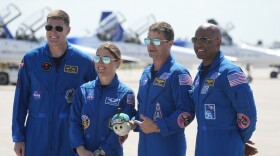 Commander Reid Wiseman and his crew spent Wednesday thanking all those who helped send them on the record-breaking flight.
 -
 Since 1991, the USF College of Marine Science has hosted Oceanography Camp Especially for Girls. Every summer, 30 eighth-grade grad go on a research expedition and do what marine scientists do.
 -
 NASA could look at other options for a critical moon supply delivery if Blue Origin can't get back to flying in time for the agency's ambitious moon base timeline.


